
History has a funny way of echoing itself, although we often refuse to listen until the volume reaches a deafening roar. Think back to the winter of 1775, when the American colonies were trapped in a paralyzing cycle of hesitation, bound by a lingering, sentimental attachment to the British Crown even as British muskets drew blood on colonial soil. The political discourse of the day was bogged down in polite compromise, cautious incrementalism, and a desperate hope that things would somehow return to “normal.”
Then came Thomas Paine, and with a few sharp, unsparing strokes of his pen, his revolutionary pamphlet Common Sense tore through the fog of hesitation. Paine did not offer polite academic theory; he appealed to raw logic, human dignity, and the self-evident truth that an island cannot indefinitely rule a continent. He shocked the public out of its complacency by pointing out the sheer absurdity of the status quo.
Today, we find ourselves standing at an eerily similar historical precipice, where the noise of modern American politics is deafening and is dominated by performative outrage, corporate oligarchy, systemic gridlock, and the rise of populist movements that trade genuine governance for spectacle. We are told that our current democratic decay is just “how things are,” that polarization is permanent, and that we must simply accept a system captured by the ultra-wealthy and partisan extremism.
Just as Paine diagnosed the ailments of 18th-century colonial governance, contemporary critical inquiry reveals that our current architecture has severely drifted from the foundational mandates of life, liberty, and equality. We are suffering from a profound crisis of democratic literacy. We treat politics like a spectator sport or a team loyalty test, forgetting that a republic requires vigilant, active, and critically thinking citizens to survive.
America doesn’t need another round of superficial campaign slogans or hollow bipartisan handshakes. It needs a modern awakening. We need a return to foundational logic that strips away the elite rhetoric protecting the overclass. We need to look at our institutions, our economy, and our leadership through an unblinking, critical lens.
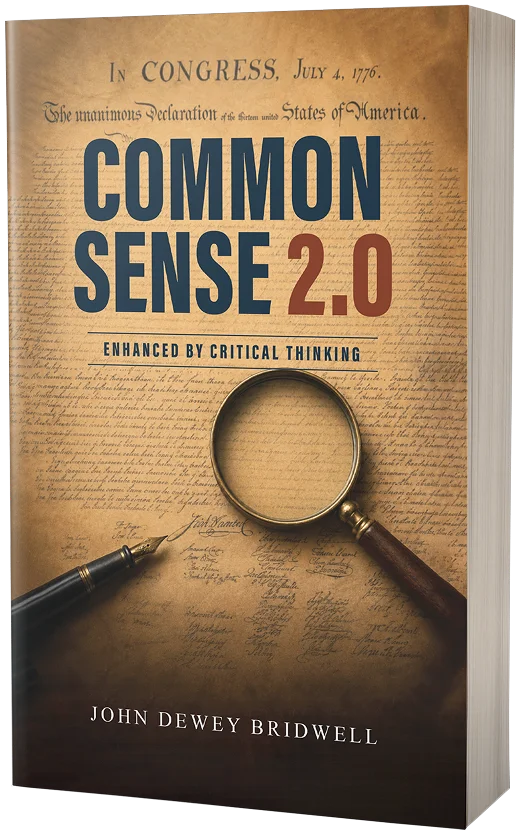
If you are ready to look past the political noise and discover the blueprint for national renewal, grab your copy of Common Sense 2.0: Enhanced by Critical Thinking by John Dewey Bridwell today and join the conversation on America’s future.
Common Sense 2.0: Enhanced by Critical Thinking analyzes the state of America 250 years after the Declaration of Independence, arguing that the nation has failed to uphold its founding mandates for equality, life, liberty, and the pursuit of happiness. It identifies the Constitution as a flawed document that has allowed for the rise of authoritarian leadership and systemic inequality. The author questions the current presidency and describes the administration as the “ugly head” of a larger, dangerous political iceberg characterized by conservatism, unbridled capitalism, and the influence of the wealthy. The narrative culminates in a call for a “redeclaration of independence” from these forces, suggesting a political agenda to reclaim the foundational principles to make America great again.
Read the book on Amazon: https://a.co/d/092tTEho