
Businesses use mission statements to define what they stand for, what they hope to accomplish, and how they intend to serve the people who depend on them. The same idea can be applied to a nation.
A country may not use the term mission statement, but it still needs a clear sense of purpose. Without one, laws, institutions, and political decisions can drift away from the principles they were meant to serve.
For the United States, that purpose can be traced to the Declaration of Independence.
The Declaration established more than a break from British rule. It identified principles that gave meaning to the new nation. Equality, Life, Liberty, and the Pursuit of Happiness were presented as fundamental rights. Government was given the responsibility of securing those rights, and its authority was to come from the consent of the governed.
Those ideas can be viewed as the foundation of a national mission.
A mission statement would not replace the Constitution or the law. Instead, it would provide a standard by which both could be judged. It would ask whether public institutions are protecting rights, serving citizens fairly, and remaining accountable to the people.
That kind of standard becomes especially important when political disagreements grow intense. Parties may disagree about taxes, health care, education, immigration, environmental policy, or the role of government. Yet those debates should still be connected to a larger question: What is the country trying to achieve for its people?
A national mission can also help citizens evaluate progress. If equality is part of the mission, then discrimination and unequal treatment deserve attention. If liberty is part of the mission, then personal freedom must be protected while respecting the rights of others. If the Pursuit of Happiness matters, then Americans must consider the conditions that allow people to live secure and meaningful lives.
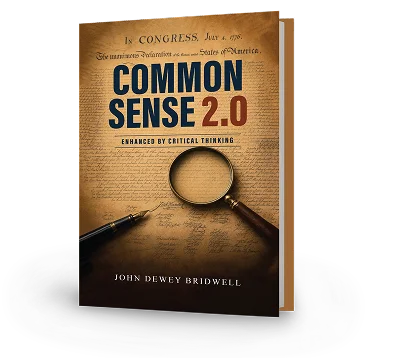
John Dewey Bridwell develops this idea in Common Sense 2.0: Enhanced by Critical Thinking. The book proposes what he calls the American Democratic Mission, a framework built around the founding principles of the Declaration of Independence and the responsibilities that follow from them.
The purpose is not to reduce a complicated country to a slogan. It is to give Americans a clearer way to think about where the nation is going and whether its institutions are helping it get there.
A mission statement cannot solve every political problem.
But a country that understands its purpose is in a stronger position to recognize when it has lost its way. And for America, the starting point may already have been written in 1776.